

If you're a videographer, broadcast journalist, or film crew member, you already know the pain of checking in heavy gear — cameras, lighting rigs, sound equipment — and watching the baggage fees stack up before you've even left the terminal. What most media professionals don't realize is that several major airlines offer dedicated media baggage rates that can save hundreds of dollars per trip. Others offer nothing at all. Knowing the difference before you book could be one of the smartest cost-saving moves you make this year.
The airlines that have your back
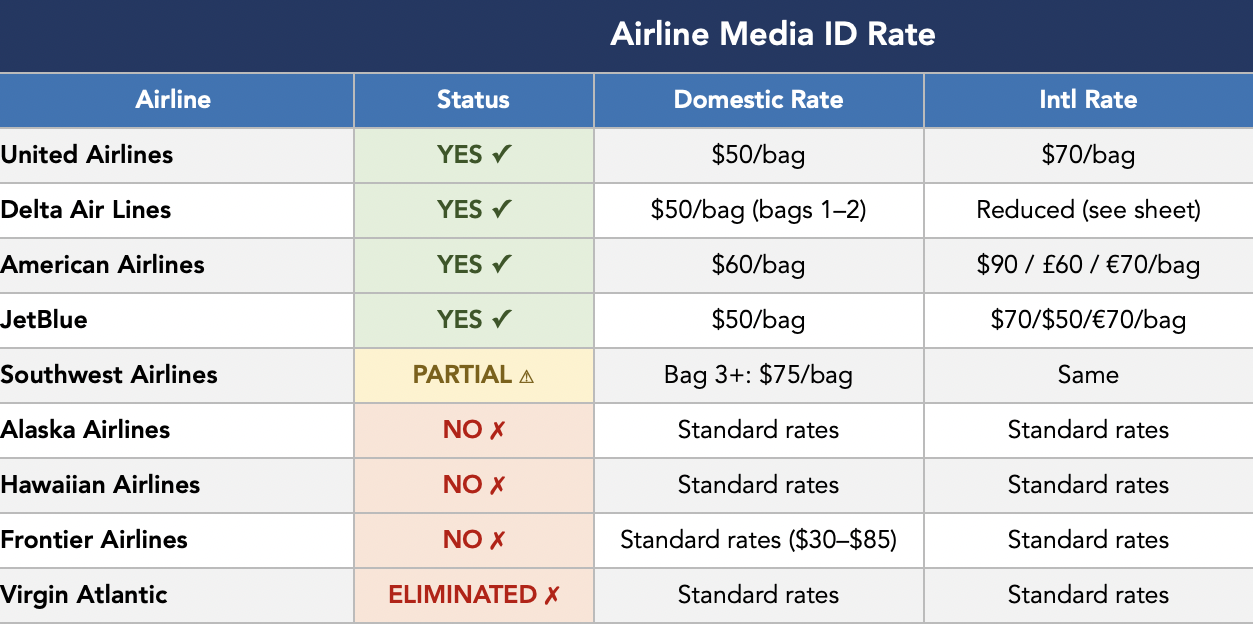
Four major U.S. carriers — United, Delta, American, and JetBlue — offer genuine flat-rate media pricing that replaces the punishing standard oversize and overweight fees.
United Airlines charges a flat $50 per bag domestically and $70 internationally, up to 99.9 lbs per bag and 25 bags per flight. No overweight surcharge. No oversize surcharge. Just show up at the staffed ticket counter with your credentials and your cases clearly labeled with your company name. Give yourself 30–45 minutes for check-in, especially at smaller airports.
Delta Air Lines matches those rates — $50 domestic, $70 international (or €60 in Europe) — and goes further by letting you lock in the pricing before you even get to the airport. Email your credentials to media.bags@delta.com at least 24 hours before departure and Delta will add a remark to your reservation. For larger crews and equipment-heavy shoots, that advance coordination can save a lot of stress at the counter.
American Airlines is slightly higher at $60 domestic and $90 international, but overweight and oversize fees are waived, and you can carry up to 25 bags at that rate. AA recommends reaching out to media.bags@aa.com in advance to confirm your eligibility, particularly if you're using a corporate account or heading to a production event.
JetBlue charges $50 per bag domestically (and in Latin America) and $70/$50/€70 internationally, up to 99 lbs. The catch: you need to submit a formal Media Bag Request Form along with your credentials at least three business days before travel. The rate isn't available on Blue Basic fares, JetBlue Vacations, or JetBlue Groups bookings, and a handful of specific routes are excluded — so double-check before you commit.
The partial win: Southwest
Southwest Airlines occupies its own lane. Your first two checked bags are still charged at standard rates — but from the third bag onward, you pay $75 each, and critically, oversize and overweight fees are waived on media equipment. For crews traveling light or who can consolidate gear into one or two cases, the benefit is limited. For larger productions checking five, ten, or more pieces of equipment, the fee waivers on heavy cases can add up fast.
The airlines that offer nothing
Three carriers — Alaska Airlines, Hawaiian Airlines, and Frontier Airlines — currently offer no dedicated media rate whatsoever. Media credentials won't move the needle at check-in.
Alaska and Hawaiian apply their standard baggage fees across the board.
Alaska charges $35 for the first bag and $45 for the second, with a $100 overweight surcharge on top.
Hawaiian adds a $50 surcharge for bags between 51–70 lbs and $100 for oversized bags. Elite frequent flyer status on either airline may get you a free standard bag, but overweight and oversize fees apply regardless.
Frontier doesn't have a formal media program either, though Fly With Media ID is accepted as valid credentials should their policy change. Fees vary significantly depending on when you purchase — $30 if booked at time of reservation, up to $85 if you wait until the gate.
The one that changed
If you've flown media gear on Virgin Atlantic before, take note: as of mid-2025, Virgin eliminated its media baggage rates entirely. All equipment now falls under standard baggage policy, and media credentials no longer waive any fees. Economy and Premium passengers are capped at 23 kg (50 lbs) per bag; Upper Class gets 32 kg (70 lbs). If you're planning a transatlantic production shoot, factor this into your cost comparisons.
Key takeaways
1. Book with United, Delta, American, or JetBlue when possible. These four carriers offer the most favorable and clearly defined media rates. If you have route flexibility, choosing one of these airlines can save a significant amount per trip — especially on equipment-heavy shoots.
2. Don't wait until the airport. Delta and American both recommend contacting them in advance. JetBlue requires it. Showing up without pre-approval or pre-arranged remarks on your reservation risks delays, confusion, or being charged standard rates by an agent who isn't familiar with the media policy.
3. Know who qualifies — and who doesn't. Media rates apply to professionals representing TV networks, broadcasters, and commercial film or production companies. They do not apply to independent YouTubers, content creators, or gamers. You'll need company-issued credentials, a business card, or a government-issued ID that reflects your employer.
4. Always check bags at a staffed ticket counter. This applies across all carriers. Kiosks cannot process media rates — without a human agent, you'll pay standard fees.
5. Verify before every trip. Airline policies change. Virgin Atlantic's elimination of media rates in mid-2025 is a recent reminder. Before each booking, confirm current pricing directly with the airline — what was true last year may not be true today.
Traveling with media equipment doesn't have to mean bracing for a surprise fee at check-in. A little advance planning — choosing the right airline, reaching out before travel, and arriving with the right credentials — can make the difference between a smooth departure and a stressful one.
Policy, rates and eligibility are subject to change — always verify directly with the airline before travel.


