


Southwest Airlines has undergone the most dramatic policy transformation of any major U.S. carrier in the past year, ending its 54-year "Bags Fly Free" era and introducing checked bag fees for the first time in company history. Despite this shift, Southwest still maintains a specific waiver for professional media equipment that sets it apart from most competitors. This guide covers what changed, what the media equipment waiver still covers, and the new lithium battery restrictions that directly affect photographers and videographers.
What Changed: The End of "Bags Fly Free"
For more than 50 years, Southwest's signature policy allowed every passenger to check two bags for free, regardless of fare class. That ended on May 28, 2025. The shift represented Southwest's most significant operational change in decades, moving the airline from the most generous checked-bag policy among U.S. carriers to a fee structure aligned with industry norms.
Less than a year later, Southwest raised those new fees further. Citing rising fuel costs, Southwest increased its first- and second-bag fees by $10 each, effective on all reservations ticketed or changed on or after April 9, 2026.

Carry-on bags and personal items remain free on every fare, including Basic Economy, with no overhead bin restrictions tied to fare class — this has not changed and remains one of Southwest's genuine advantages for media professionals who can fit gear into carry-on dimensions.
Who Still Gets Free Checked Bags
Southwest preserved free checked bag benefits for several categories of travelers, which is directly relevant to media professionals who fly Southwest regularly or who can qualify for one of these fare types.
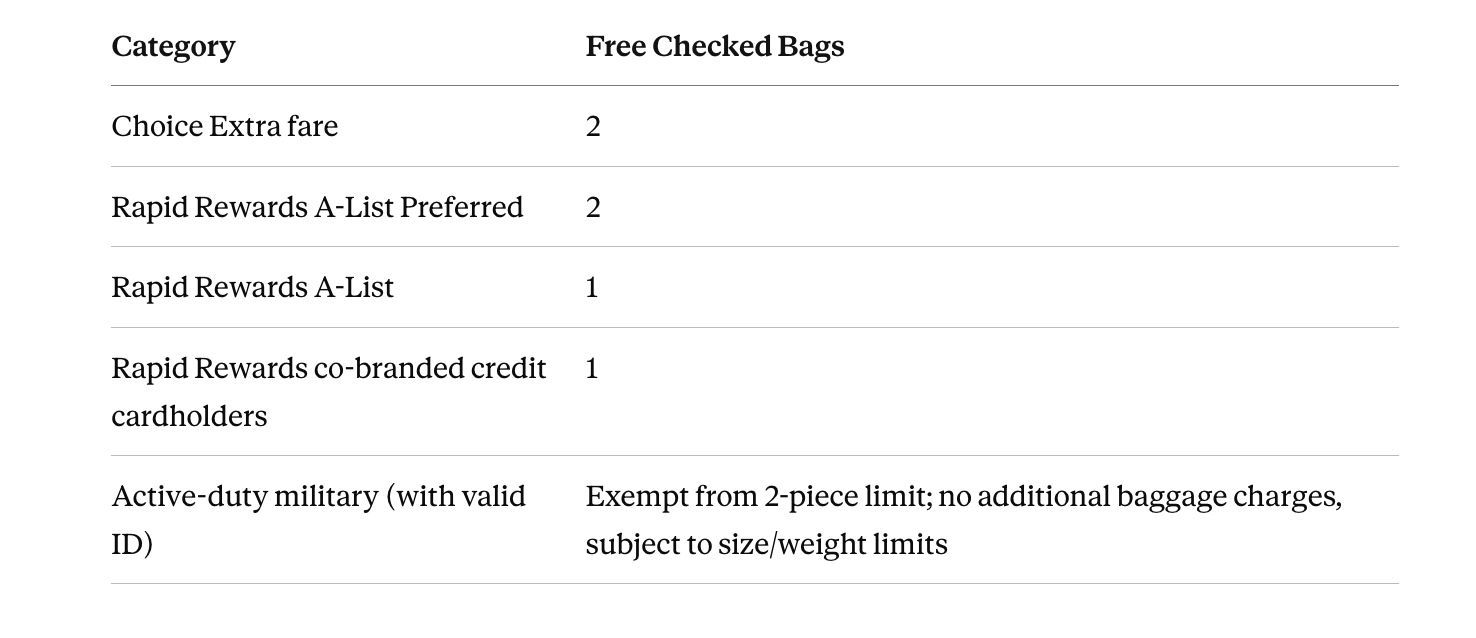
These free-bag benefits extend to up to eight additional passengers on the same reservation for A-List, A-List Preferred, and Rapid Rewards credit card members — valuable for production crews traveling together under a single elite member's benefit.
Important limitation: Checked bag benefits from status or credit cards do not apply on flights booked with a partner carrier. If your itinerary includes a codeshare or partner segment, confirm whether your free bag benefit actually applies to that leg.
A-List Preferred status requires 40 qualifying one-way flights or 70,000 tier qualifying points per calendar year. Both A-List tiers also come with boarding priority — A-List Preferred boards before Group 1, and A-List boards in Group 1, as of Southwest's April 30, 2026 boarding restructure. Earlier boarding meaningfully reduces the risk of a camera bag being gate-checked due to full overhead bins.
Standard Checked Baggage Rules
Southwest's standard size and weight limits apply to all checked bags, including most media equipment that doesn't qualify for the media waiver described below.
- Maximum weight: 50 lbs (23 kg) per bag
- Maximum size: 62 inches (158 cm), total of length + width + height
- Absolute maximum accepted: 100 lbs (45 kg) and 80 linear inches (203 cm) for checked baggage; anything beyond this must ship via Southwest Cargo
Overweight and Oversize Fees (From April 2026)
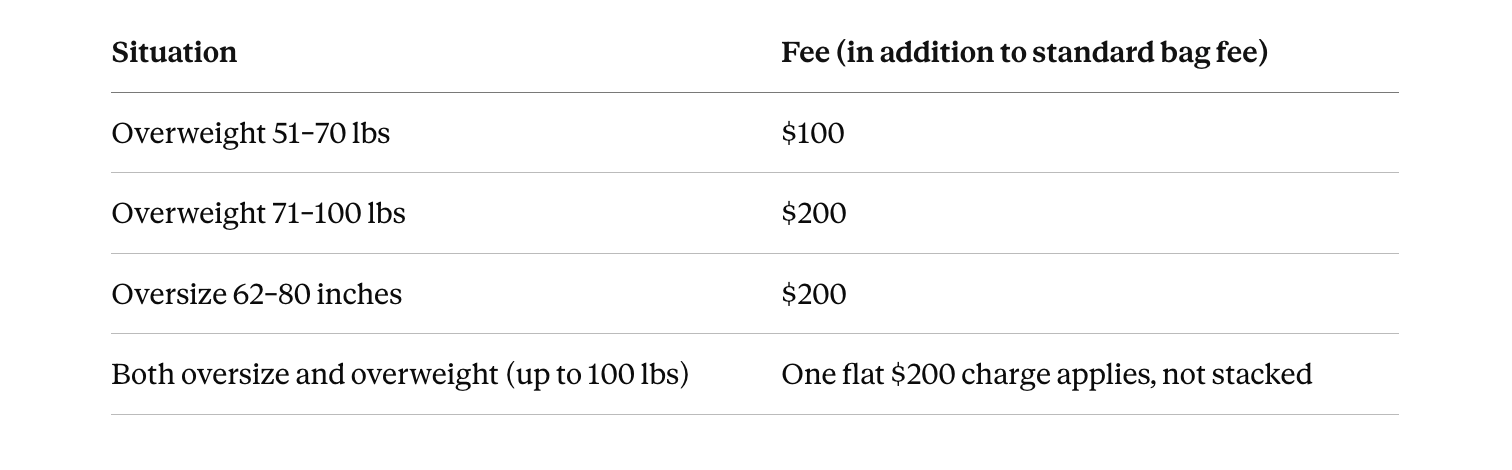
This is a notable structural detail: unlike some carriers that stack overweight and oversize fees, Southwest charges only the higher single $200 fee when a bag is both oversized and overweight, as long as it doesn't exceed 100 lbs. Beyond 100 lbs or 80 linear inches, the item is not accepted as checked baggage at all.
The Media Equipment Waiver: What Still Applies
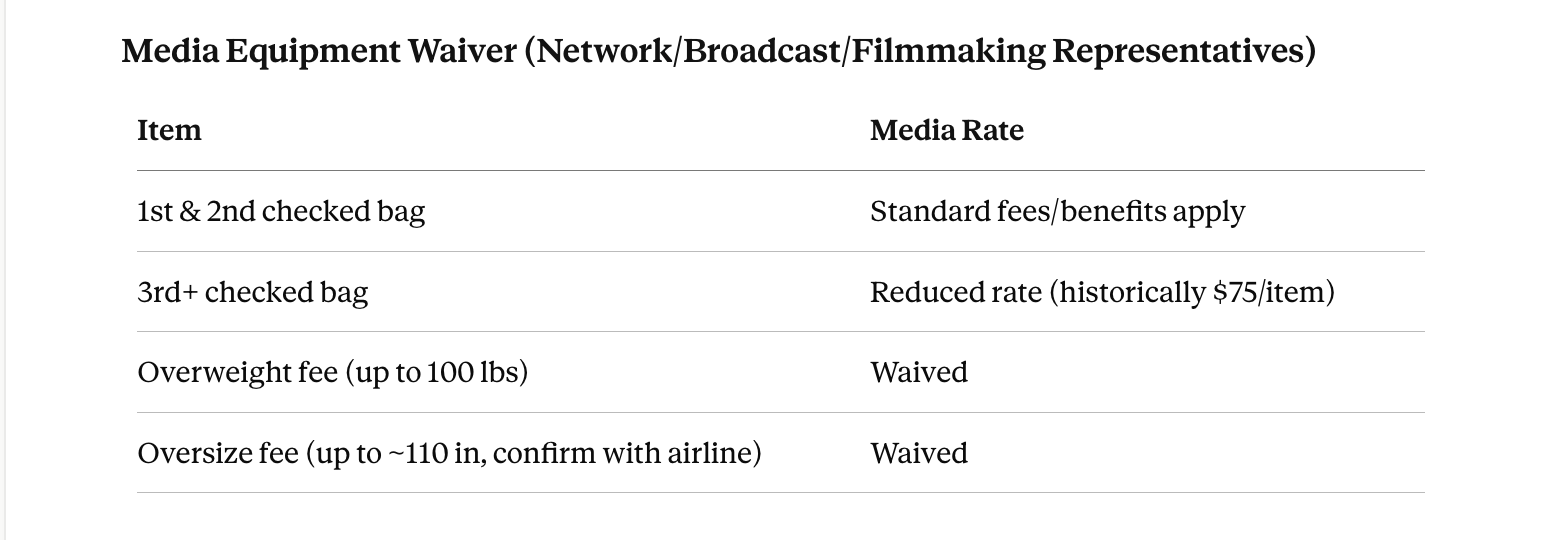
Southwest maintains a specific policy for camera, film, video, lighting, and sound equipment, separate from its general special-baggage and sports-equipment policies. This waiver predates the 2025 fee changes and continues to apply within the airline's new fee structure.
Who qualifies: Camera, film, video, lighting, and sound equipment is accepted under this policy when presented by a representative of a network or local television broadcasting company, or a commercial filmmaking company.
What the waiver covers:
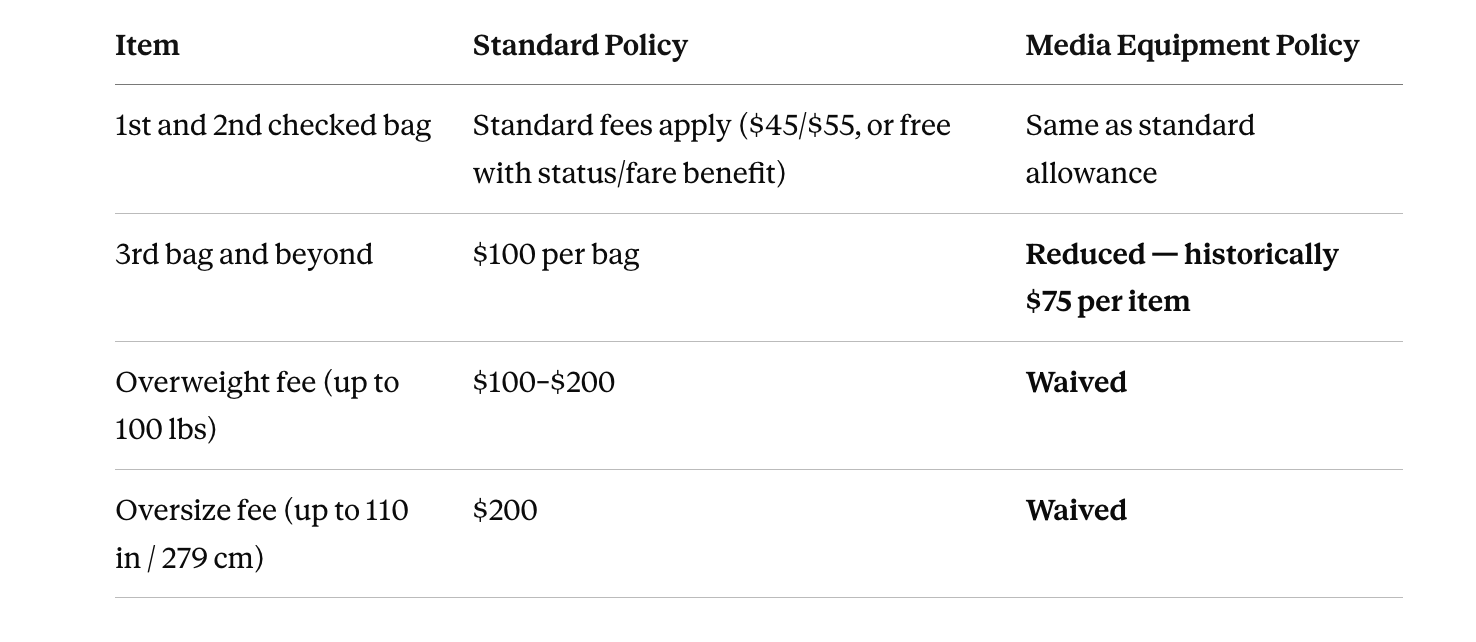
Important clarification on size limits: Some sources reference the media equipment oversize waiver extending up to 110 inches (279 cm), notably larger than Southwest's standard 80-inch oversize ceiling for ordinary baggage. This is a meaningful distinction for production cases — equipment that would be refused entirely as standard checked baggage (anything over 80 inches) may still be accepted under the media equipment policy up to 110 inches. Confirm this limit directly with Southwest before your trip, as it is one of the more variable details in their special-items policy and is not consistently published in the same way across all of Southwest's official channels.
What you need to present at check-in:
- Identification establishing you represent a network, local broadcasting company, or commercial filmmaking company
- Your media equipment cases should be processed at the airport, and clear company identification on cases helps the process move smoothly
Unlike United or American, Southwest does not require pre-booking or PNR documentation for this waiver — but exact enforcement and the precise oversize limit can vary by airport and agent, so always confirm directly with Southwest before traveling with unusually large or heavy production equipment.
Lithium Batteries: Major New Restrictions for 2026
This is the single most important update for media professionals flying Southwest, and it represents a meaningful tightening of rules specifically relevant to photographers and videographers who travel with multiple battery packs.
New Portable Charger Limit (Effective April 2026)
Southwest now limits passengers to one portable charger (power bank) per flight. This is a significant change from the airline's previous, more permissive policy and is stricter than many competitors. The airline's vice president of safety and security cited a sharp rise in lithium battery incidents industry-wide as the reason for the change — the FAA recorded a total of 709 verified lithium battery incidents over a 20-year period, with the rate of incidents accelerating in recent years.
What this means in practice: If you currently travel with two or three power banks to keep cameras, drones, and laptops charged through a long shoot day, you can only bring one onto a Southwest flight under the new policy. Plan your charging strategy accordingly — consider a single higher-capacity power bank (within watt-hour limits) rather than multiple smaller ones.
Additional new restrictions on power bank use, effective April 20, 2026:
- Power banks can no longer be stored in overhead bins
- Power banks must be kept on the passenger's person or in under-seat storage where crew can see them
- Recharging a portable charger from the seat power outlet during flight is no longer permitted
- A power bank in active use must remain visible to cabin crew, not buried inside a bag or seat pocket
Standard Spare Battery Rules
All spare lithium batteries must travel in carry-on baggage only — never in checked bags. This applies to camera batteries, camcorder batteries, drone batteries, and any other removable lithium battery.
Quantity and watt-hour limits:
- Southwest's general guidance allows passengers to carry a relatively generous number of small spare batteries (commonly cited as up to 20 spares per person) for batteries under 100 Wh — covering the vast majority of standard camera batteries
- Batteries between 101–160 Wh require airline approval and are limited to two spares per passenger — this covers some larger professional video batteries and extended laptop batteries
- Batteries over 160 Wh are not permitted on passenger aircraft and must ship separately as cargo
Mobility Device Battery Changes
For media professionals who travel with powered mobility equipment as part of accessibility needs, note that Southwest now requires removable lithium batteries in mobility devices to be detached and carried in the cabin, with a new 300 Wh maximum capacity limit effective from January 11, 2026.
Practical takeaway: Before any Southwest assignment, count your spare batteries and power banks. If your kit includes more than one power bank, you will need to either consolidate, leave extras behind, or check with Southwest directly about exceptions. This is now a stricter limitation than the equipment weight or size rules.
Carry-On Rules
Southwest's carry-on policy remains one of the more straightforward in the industry and is unchanged by the 2025–2026 fee restructuring.
- Carry-on bag: Maximum 10 × 16 × 24 inches, free on every fare
- Personal item: Must fit under the seat in front of you; common examples include a small camera, laptop case, briefcase, or backpack
- No fare class restricts carry-on or personal item access — this differs from some competitors that limit carry-on bags on their lowest fare tiers
For media professionals: A compact mirrorless camera setup or a small camera bag can travel as a personal item at no cost on any Southwest fare. Larger camera backpacks fit the carry-on allowance, also free regardless of fare type.
Practical Packing Strategy for Southwest Flights
Use the Media Waiver, But Confirm the Details First
Given the size limit ambiguity noted above, call Southwest or check with the airline directly before a trip involving oversized production cases. Don't assume the 110-inch limit applies uniformly — get written or documented confirmation if you're checking unusually large equipment, particularly for assignments where a refused bag would be costly.
Plan Your Battery Loadout Around the New One-Power-Bank Rule
This is the most operationally disruptive change for media professionals. Audit your kit before departure:
- Identify your single highest-priority power bank for the trip
- Move spare camera batteries (which are not power banks and aren't subject to the new one-per-flight rule) into your carry-on as usual
- If your production requires more charging capacity than one power bank allows, plan to charge equipment overnight at your destination rather than relying on in-transit charging
Use Hard Cases for Checked Media Equipment
Pelican, SKB, or similar hard-shell cases remain the right choice for checked gear. Southwest's baggage handling, like any airline's, can be rough — a 2018 incident in which a Southwest baggage handler was filmed throwing a passenger's equipment-filled case is a useful reminder that hard-sided protection matters regardless of carrier.
Take Advantage of Free Carry-On for Lighter Gear
Because Southwest's carry-on and personal item allowances are free on every fare with no restrictions, this is genuinely one of the best carriers for keeping cameras, lenses, and critical gear in the cabin without paying anything extra — a real advantage over carriers that charge for carry-ons on discount fares.
Consider A-List Status If You Fly Southwest Often
If Southwest is a regular carrier for your work, A-List status (1 free bag) or A-List Preferred (2 free bags) eliminates standard bag fees entirely, and the new April 2026 boarding changes mean both tiers board ahead of the general boarding groups — directly reducing the risk of a camera bag being gate-checked on a full flight.
Weigh Cases at Home
The $100–$200 overweight fees apply quickly past 50 lbs. A luggage scale at home prevents surprises, and remember that Southwest charges only the higher single fee (not stacked fees) if a bag is both overweight and oversized — slightly more forgiving than some competitors' compounding fee structures.
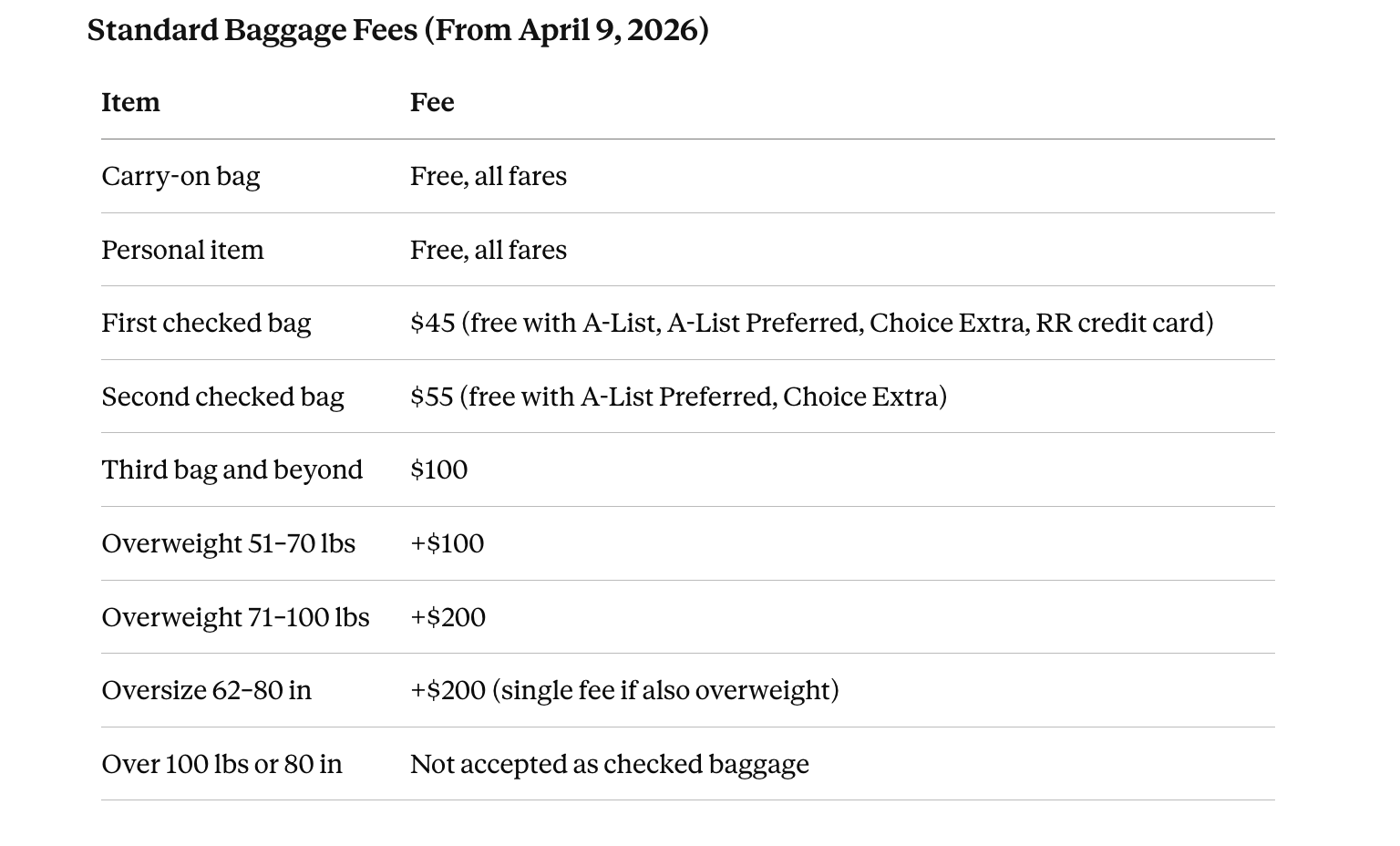
Summary: Fee Reference for Media Professionals

Fly With Media's Assessment
Southwest's transformation from "Bags Fly Free" to a standard fee structure marks the end of an era, but the airline's continued media equipment waiver — covering overweight and oversize fees for qualifying broadcast and filmmaking professionals — remains a genuine point of differentiation. Combined with Southwest's unrestricted free carry-on policy across every fare class, the airline still offers real value for media professionals, particularly those traveling with equipment that fits in the cabin.
The new one-power-bank-per-flight restriction, introduced in April 2026, is the most consequential change for working photographers and videographers specifically, and it requires real adjustment to packing and charging routines. We encourage media professionals to plan battery logistics carefully before any Southwest assignment and to confirm the exact oversize equipment limits directly with the airline, given some inconsistency in how that detail is published.
Fee data and policy details sourced from Southwest Airlines' official Help Center, Rapid Rewards tier pages, and Southwest's April 2026 lithium battery policy announcements. Always verify current fees and the media equipment waiver directly with Southwest at southwest.com or via the Help Center article "Traveling with Large Media Equipment" before travelling, as policies are subject to change and can vary by airport.


