


Alaska Airlines does not offer a dedicated media rate. All film, photography, broadcast, and journalism equipment is subject to the airline's standard checked baggage policies and fees — no exemptions, no special pricing, no credential-based waivers. This guide explains the current fee structure, what changed in 2026, how to reduce costs through status and credit card benefits, and how to move your gear safely.
What Changed: April 2026 Fee Increase
Alaska Airlines raised its checked baggage fees in April 2026, citing ongoing fuel price volatility. The new fees apply to all flights booked on or after April 10, 2026.
The online prepay discount that previously saved $5 per bag has been removed entirely. There is no longer a cheaper rate for booking bags in advance versus at the airport — all checked bags cost the same regardless of when you add them.

Atmos Rewards status members and eligible Alaska/Hawaiian credit cardholders are not affected by this change and retain their existing free bag benefits.
Standard Baggage Rules for Media Equipment
Carry-On (Cabin Baggage)
Every fare includes one carry-on bag and one personal item at no charge.
- Carry-on bag: Maximum 22 × 14 × 9 inches (56 × 36 × 23 cm) including wheels and handles, or 45 linear inches total. Alaska enforces these dimensions with bag sizers at many gates.
- Personal item (purse, briefcase, laptop bag, small backpack): Must fit completely under the seat in front of you. No exact dimensions published — the seat pocket is the guide.
- Weight: Alaska publishes no weight limit for carry-on bags, but you must be able to lift the bag into the overhead bin unassisted. If a bag is clearly too heavy to handle safely, crew can require it to be checked.
Note for media professionals: A camera backpack that fits under the seat counts as your personal item. A larger camera bag that fits only in the overhead bin counts as your carry-on. Choose your camera bag accordingly to keep both slots free.
Checked Baggage
Standard checked bags must not exceed 50 lbs (22.7 kg) in weight and 62 linear inches (length + width + height combined) in size.
- First Class passengers receive a higher weight allowance of 70 lbs per bag before overweight fees apply.
- Maximum accepted weight for any checked bag is 100 lbs. Bags over 100 lbs are not accepted.
- Maximum accepted size is 115 linear inches. Bags over 115 linear inches (292 cm) are not accepted as checked baggage and must be shipped as cargo.
Overweight and Oversize Fees
This is where costs escalate fastest for media professionals traveling with heavy camera cases, grip equipment, or lighting rigs.
Current Fee Structure (tickets booked April 10, 2026 or later)

These fees are in addition to the standard checked bag fee. A single oversize, overweight Pelican case on a one-way flight could cost $45 (bag fee) + $300 (oversize + overweight combined) = $345 for one bag, one direction.
Important: If a bag is both overweight and oversized, both surcharges apply as a combined total, as shown above.
Who Gets Free or Discounted Bags
Atmos Rewards Elite Status
Alaska Airlines' loyalty program — now called Atmos Rewards — offers free checked bags as a core benefit for elite members. This is one of the most practical ways for frequent Alaska flyers to offset media gear costs.
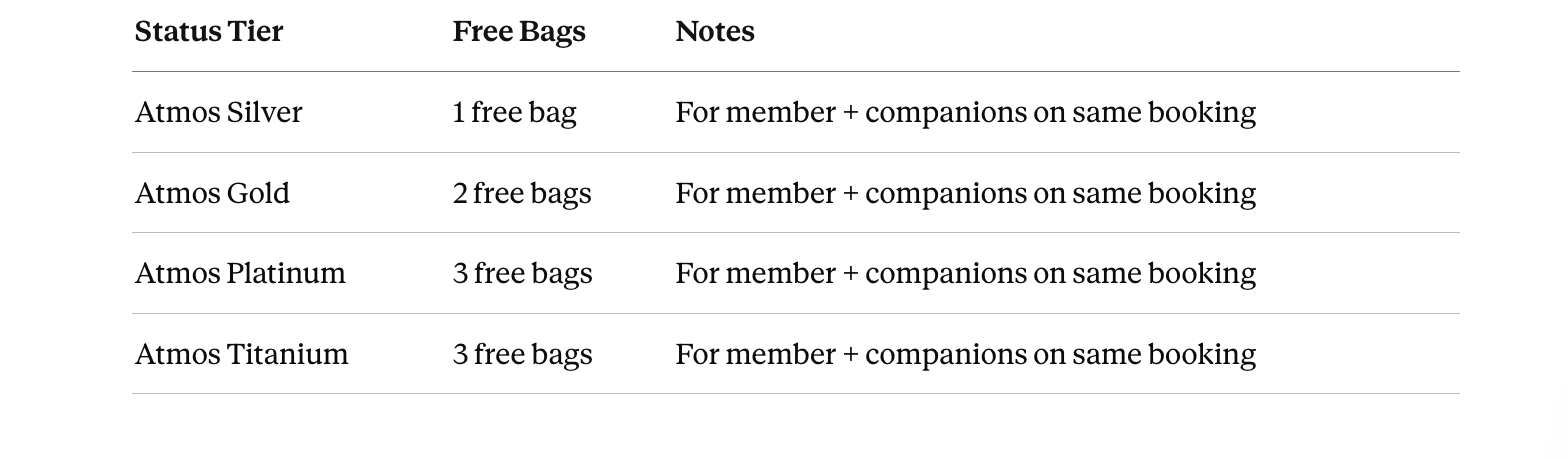
Status qualification thresholds for 2026: Silver at 20,000 status points, Gold at 40,000, Platinum at 80,000, Titanium above that. Status points can be earned through Alaska and Hawaiian flights, partner airlines, credit card spend, and non-airline partners.
Critical caveat: Elite status free bags cover standard checked bag fees only. Overweight and oversize surcharges apply regardless of status tier. A Titanium member still pays the overweight and oversize fees on a heavy production case.
Alaska Airlines Visa Credit Card
Holders of an Alaska Airlines Visa or Visa Business card receive the first checked bag free for themselves plus up to six companions on the same reservation — but only when the airfare is purchased with that card. The benefit does not apply to flights booked through third-party agencies or non-qualifying merchants. Like status benefits, this waives the standard bag fee only; overweight and oversize fees still apply.
First Class Passengers
First Class passengers receive a 70 lb weight allowance per bag before the overweight fee kicks in (compared to 50 lbs in all other cabins). This is meaningful for media gear: a 60 lb camera case that would cost a $100 overweight fee in economy travels free in First Class.
Other Waivers
- Active-duty U.S. military (on travel orders): Up to five free bags, each up to 70 lbs, up to 115 linear inches — no overweight or oversize surcharges.
- Club 49 (Alaska residents): Three free bags on intrastate Alaska flights; two free bags on flights to/from Alaska.
- Huaka'i by Hawaiian (Hawaiʻi residents): One free bag on Neighbor Island flights. Intra-Hawaiʻi flights have a separate first bag fee of $30 and second bag fee of $40.
- oneworld Ruby members (Tier 1 elites): One free bag plus companions.
Lithium Batteries: The Non-Negotiable Rule for Media Professionals
This is the single most important operational rule for photographers, videographers, and audio/video crews. It is not an airline preference — it is a federal and IATA safety requirement.
Spare lithium batteries must travel in carry-on baggage only. They cannot be placed in checked bags under any circumstances.
This applies to:
- Camera batteries (LP-E6, EN-EL15, NP-FZ100, etc.)
- Camcorder and cinema camera batteries (V-mount, Gold Mount, Anton Bauer, etc.)
- Drone batteries
- Power banks and portable chargers
- Laptop spare batteries
- Audio recorder batteries
Batteries installed in a device (e.g., a laptop with the battery inside) may travel in checked bags if the device is fully powered off and protected from accidental activation. But any spare battery — loose, in a case, or in a pouch — must be in the cabin.
Watt-hour limits:
- Up to 100 Wh: No restriction, carry-on permitted.
- 101–160 Wh: Maximum two spare batteries per person, carry-on only, airline approval required. Declare at check-in.
- Over 160 Wh: Not permitted on passenger aircraft. Must be shipped as dangerous goods cargo.
Most consumer camera batteries (LP-E6: ~14 Wh, EN-EL15: ~14 Wh) are well below the 100 Wh threshold. Large cinema camera batteries (Anton Bauer Dionic HD: ~96 Wh) also fall under 100 Wh. V-mount batteries at 190 Wh and above exceed the 160 Wh limit and cannot fly on commercial aircraft at all — ship them via approved dangerous goods freight.
An incident on an Alaska Airlines flight in early 2026 in which a power bank caught fire mid-flight resulted in a hospitalized passenger and underscores why this rule exists. Batteries discovered in checked bags at the security checkpoint will be confiscated. Plan accordingly.
Practical Packing Strategy for Media Professionals
Carry On Your Most Critical and Irreplaceable Gear
Camera bodies, primary lenses, memory cards, and all spare batteries should always travel in the cabin with you. Alaska Airlines, like all carriers, accepts no responsibility for lost or damaged valuables in checked bags. If your checked case is delayed or lost, you need to be able to shoot with what you have on board.
Check the Heavier Supporting Equipment
Flash units, light stands, sandbags, reflectors, C-stands, audio recorders, and spare chargers are better candidates for checked baggage. Their loss or delay is painful but usually workable; losing camera bodies is a production shutdown.
Use a Hard Case for Checked Gear
Pelican, SKB, and similar hard-shell cases are the correct solution for checked media equipment. Use a TSA-approved lock, keep a detailed packing list inside the case, and photograph the packed contents before closing the lid. This matters significantly for insurance claims.
Know Your Case Dimensions Before You Arrive
Standard Pelican cases measured in linear inches:
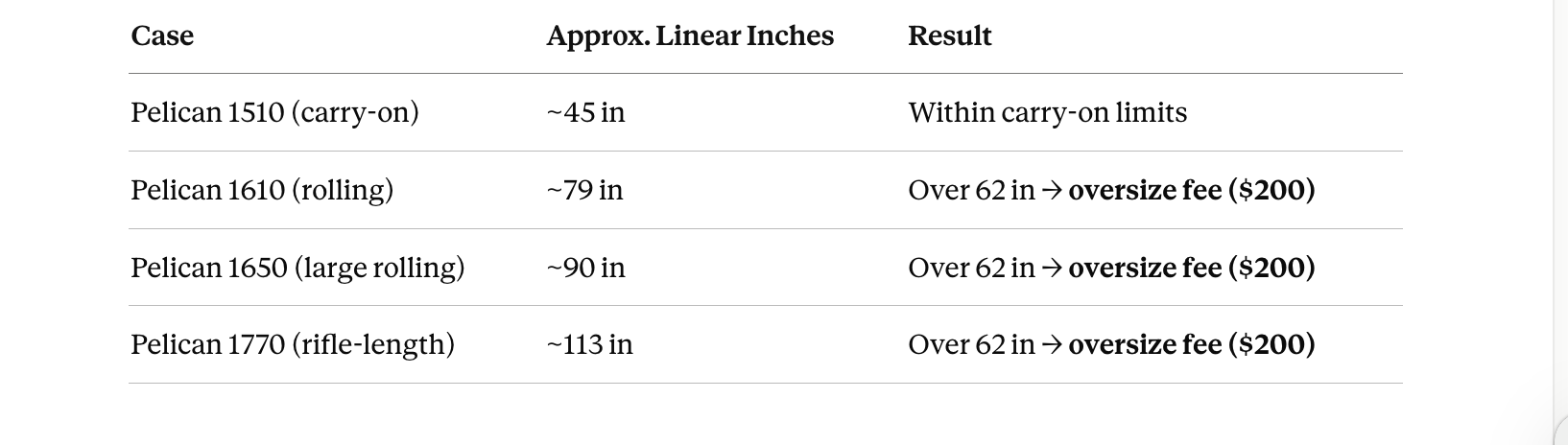
Nearly every production-grade hard case exceeds 62 linear inches. Budget for the $200 oversize surcharge on each large case, each direction.
Weigh Your Cases at Home
The 50 lb limit is firm. A bag that checks in at 52 lbs costs $100 on top of the bag fee — $145 total for one bag. A $15 luggage scale at home eliminates that entirely. Redistribute gear between cases if needed to keep each under 50 lbs. First Class passengers have a 70 lb threshold if the upgrade cost is less than the overweight fees across multiple bags.
Do the Math: Shipping vs. Flying with Gear
On gear-heavy assignments, shipping equipment directly to the destination via FedEx, UPS, or a specialist gear shipper can be cheaper and less stressful than paying oversize and overweight fees on multiple cases. A round-trip with three oversize cases generates $200 × 3 × 2 = $1,200 in oversize fees alone, before bag fees. Compare that against freight costs for your specific gear weight and route.
At the Airport: Practical Tips
Gate checks on regional aircraft: Alaska operates many routes on regional Horizon Air and SkyWest aircraft with smaller overhead bins. If your camera bag fits the standard 22 × 14 × 9 in limit but the overhead bin is full, gate agents will offer a free valet gate check. Your bag goes in the hold at no cost and is returned to you at the jet bridge at your destination. This is common on shorter routes; plan for it and ensure your batteries are already in your pockets or personal item before boarding.
Priority boarding for overhead bin access: If overhead bin space is a concern, Atmos Silver, Gold, Platinum, and Titanium members all receive priority boarding. Silver boards with Group B; Gold and Platinum board with Group A; Titanium boards with First Class. Earlier boarding significantly reduces the risk of camera bags being gate-checked.
Alaska's 20-minute baggage guarantee: Alaska promises that checked bags will arrive at the carousel within 20 minutes of landing, or they will credit you 2,500 Atmos Rewards bonus points or a $25 discount voucher. This is a meaningful protection compared to most carriers. If your checked gear is delayed, file a claim immediately after the 20-minute window.
Summary: Fee Reference for Media Professionals
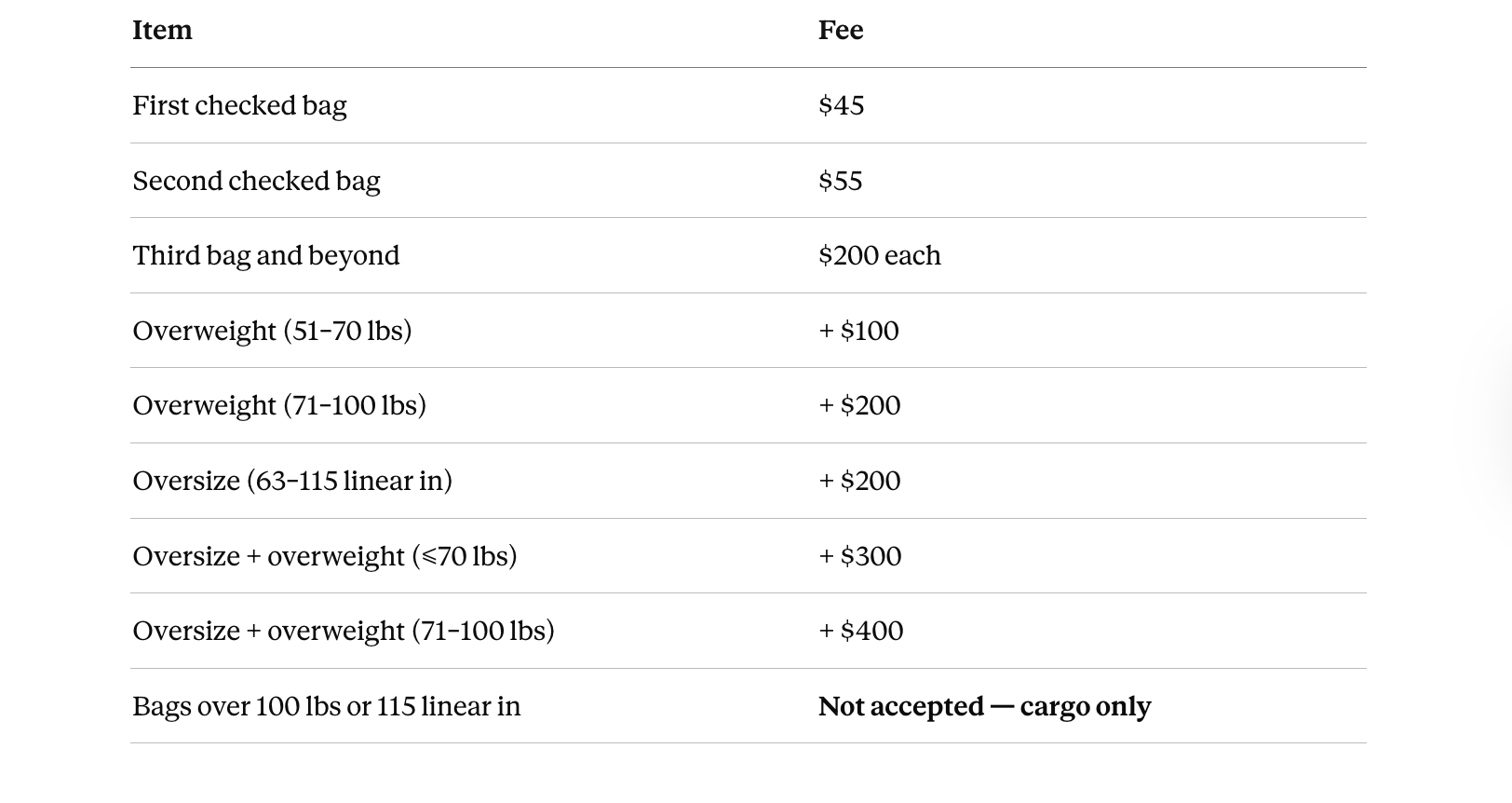
Atmos Silver/Gold/Platinum/Titanium and Alaska Visa cardholders waive the standard bag fees above. Overweight and oversize fees apply to everyone.
Fly With Media's Position
At Fly With Media, we are disappointed that Alaska Airlines has chosen not to offer a media rate. The 2026 fee increases — including the elimination of the online prepay discount — add further financial pressure on working journalists, photographers, and production crews who rely on Alaska's network, particularly across the West Coast and routes to Alaska and Hawaiʻi where Alaska has dominant coverage.
We strongly encourage Alaska Airlines to reconsider and establish a media baggage policy that recognizes the professional needs of the industry. We hope this remains an exception rather than a trend across carriers.
In the meantime, media professionals flying Alaska should:
- Build oversize and overweight fees into every production budget
- Pursue Atmos Rewards elite status if Alaska is a regular carrier
- Consider First Class on heavily gear-loaded trips, where the 70 lb weight allowance offsets fees
- Ship the heaviest, most oversized equipment separately for longer assignments
- Always carry batteries, cameras, and irreplaceable gear in the cabin
Fee tables sourced from Alaska Airlines' official news release, April 2026. Always verify current fees at alaskaair.com before travelling, as policies are subject to change.


