Close the Shade (Unless You're a Kid): Window Seat Etiquette
November 9, 2026
I'll just say it: I'm a shade-down person.
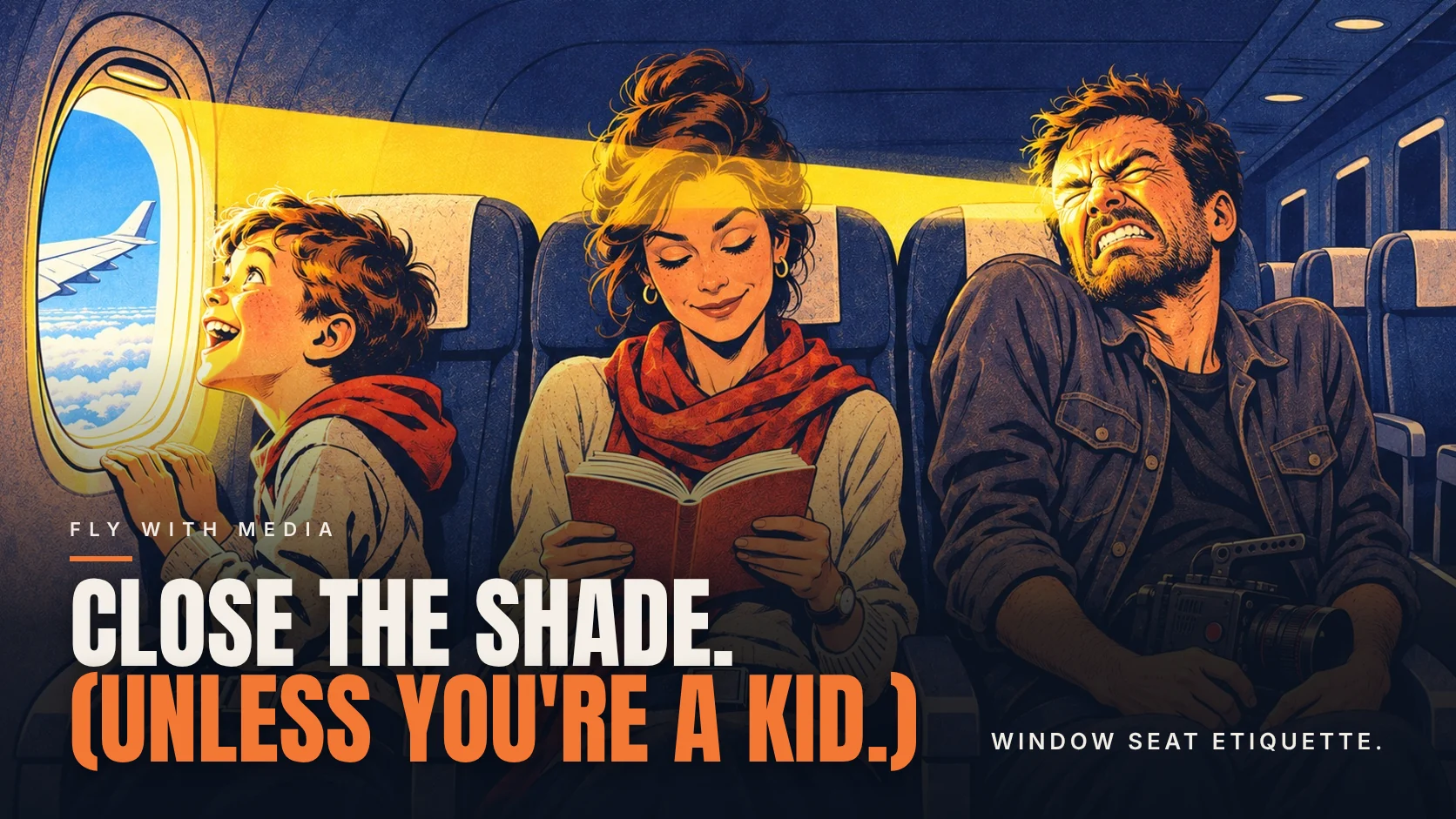
Up for takeoff. Up for landing. Down for everything in between. That's just my personal preference. There's one exception I'll always make: kids.
To be clear, if you're in the window seat, the shade is yours. You picked that seat, and you're entitled to it. This is one traveler's opinion, plus some data on why I lean the way I do. The only part that isn't opinion is takeoff and landing.
My take, in one line
Shade up for takeoff and landing (that part's safety). After that, I keep mine down. Unless there's a kid who wants to look out.
Why it's up for takeoff and landing
This is the part everyone should follow, because there's a real reason for it. Takeoff and landing are when things are most likely to go wrong, and an open shade turns every window into a safety tool:
- Someone can spot trouble. With shades open, passengers and flight attendants can see something like an engine fire and tell the flight deck right away.
- The crew can pick a safe exit. Before opening a door in an evacuation, flight attendants look outside to make sure there's no fire or debris on that side.
- Your eyes are already adjusted. If you have to get out, your eyes are used to the light outside, so you're not stumbling out half blind. It's the same reason the cabin lights get dimmed for landing at night.
- Rescuers can see in. People outside can see what's happening in the cabin.
In the US this is an airline procedure, not a federal law, and it varies by airline. But when United stopped asking for it in 2022, its own flight attendants' union called that a safety issue. So when the crew asks, put it up. I put mine up even when they don't ask.
Why I keep mine down
It's hot. At cruise you're above most of the atmosphere, and sunlight up there is close to full strength, about 1,366 watts per square meter. By my rough math, a patch of sun the size of a sheet of paper is around 80 watts landing on the row, like a small heat lamp aimed at your seatmates. The cabin air is cooled, but sunlight heats skin, seats and screens directly. That's why the whole row warms up the second a shade opens.
It's bright. Cruise lighting is dim. One open shade throws a beam across several rows, washes out everyone's screen and wakes up people who are trying to sleep.
It's UV. A 2015 study in JAMA Dermatology measured UV in a turboprop's cockpit. The windshield blocked UVB but let UVA through. At 30,000 feet, about an hour of that UVA gave the same skin-cancer-weighted dose as a 20-minute tanning-bed session. That was a pilot's windshield, not a passenger window, but sitting in direct sun for hours at altitude isn't nothing.
The crew often wants it, too. On overnight and long-haul flights, crews ask for shades down so people can sleep. On hot days, they'll ask you to close it after landing so the parked plane doesn't bake. And on a Boeing 787, the windows dim electronically, and the crew can darken the whole cabin from one control panel.
The kid exception
Here's where I turn into a softie.
If a kid wants to see out the window, the shade goes up. Period. Sun in my eyes? Fine. Screen washed out? I'll live.
That might be their first flight. That kid with their face pressed to the window, watching the wing and the clouds, might be the next airline captain, the next aerospace engineer or the next person who flies with a camera for a living. Nobody ever gave up on becoming a pilot because the guy in 23A was a little warm.
You can never take a kid's dream away. So if the future pilot next to you wants to look, let them look. And if you're the one in the window seat and a kid nearby is craning to see, crack it open for them.
Gear Toolkit
Plan your gear once. Pack any trip in minutes.
Plan your gear once. Pack any trip in minutes. Free during beta, no account needed to try.
Try the Toolkit freeSetting the record straight on radiation
People sometimes say to keep the shade down "because of radiation." Half true. There are two kinds:
- UV from the sun comes through the window, and the shade blocks it. That one's a good reason to close it.
- Cosmic radiation is high-energy particles from space. You get more at altitude, but it passes through the whole airplane, roof and walls included. Your shade does nothing about it.
And for passengers, it's small. Health physicists estimate a New York to Tokyo flight at about 0.0055 millisieverts (mSv) per hour, so roughly 0.07 mSv for the whole 13-hour trip. That's less than a typical chest X-ray (about 0.1 mSv). The average American gets about 6.2 mSv a year from everything. It matters more for people who fly constantly: the CDC treats it as a work exposure for flight crews, and long, polar routes and solar storms raise it. If you're a media pro flying every week, the FAA's free CARI-7 software can estimate the dose for a specific flight.
It's your window
And most people agree: in a YouGov survey for The Points Guy, 51% said the window seat controls the shade. If you want it open, that's your call. Everything above is just why I close mine. If you do keep it up, a little awareness goes a long way. If the sun is hitting your neighbor, or the cabin is dark and people are sleeping, lowering it partway is a nice gesture.
What I do
- Up for taxi, takeoff and landing. That's safety.
- Down at cruise. Just my preference.
- Peek for the view or the shot, then lower it.
- Kids get the window. Always.
- The crew outranks all of it.
Sources
- Euronews: Why you have to open your window blind for takeoff
- The Points Guy: United stops asking for window shades up (2022)
- The Points Guy: Why passengers might have to close their window shade
- Gizmodo: How the Boeing 787 Dreamliner windows work
- HyperPhysics (Georgia State University): Solar irradiance
- Sanlorenzo et al., JAMA Dermatology (2015): UV measurements in flying airplanes
- Health Physics Society: Radiation dose on a New York to Tokyo flight
- Health Physics Society: Average annual dose and chest X-rays
- CDC/NIOSH: Aircrew and cosmic ionizing radiation
- CDC Yellow Book: Jet lag disorder
- The Points Guy / YouGov: Airplane etiquette survey (2026)
This is my personal opinion, with the research above for context. Always follow crew instructions.
Media ID card
Traveling with gear? Carry proof you're a working media professional.
The Fly With Media ID card: $119 for two cards, logo included, valid four years, plus 60 days of Toolkit Pro when the beta ends.
Get your ID card