


Ask ten working photographers whether they'd ever check a camera body or lens, and you'll get something close to ten identical answers: no, not if there's any other option. That near-universal consensus is worth paying attention to, because it's not coming from airline policy — it's coming from people who've actually lost gear, watched it come back damaged, or heard enough stories from colleagues to never want to find out themselves.
Here's the honest breakdown of what should fly with you, what can reasonably go in the hold, and why the gap between those two categories is wider than most people expect.
The Default Rule: Bodies and Lenses Travel With You
If there's one piece of advice that shows up consistently across photography forums, professional associations, and travel guides, it's this: camera bodies and lenses belong in carry-on baggage, not checked. The reasoning isn't really about any one specific risk — it's that checked baggage stacks several risks on top of each other simultaneously, in a way that carry-on simply doesn't.
Checked bags get loaded, stacked, and unloaded by handlers processing enormous volumes of luggage under time pressure, which means impacts and rough handling happen at a scale individual care can't fully prevent. They're also out of your sight and control from the moment you hand them over until you see them again at baggage claim — which matters for both damage and theft, since a bag sitting unattended on a conveyor or in a cargo hold is simply more exposed than a bag staying on your shoulder. And critically, most airlines explicitly disclaim liability for electronics and valuables in checked baggage, meaning if something does go wrong, you're often left with very limited recourse from the airline itself.
None of this means checked bags are uniquely dangerous compared to checked baggage in general — it means valuable, fragile, hard-to-replace equipment is a particularly bad fit for a system that wasn't built with that kind of cargo in mind.
What Belongs in Carry-On, Without Exception
A few categories of gear are worth treating as non-negotiable carry-on items, regardless of how tight your cabin allowance is:
Camera bodies, since they're usually the single most expensive and hardest-to-quickly-replace item in your kit, and the one piece of gear an entire shoot depends on.Your primary lenses, especially anything specialized, rare, or expensive enough that sourcing a same-day replacement at your destination isn't realistic.Spare lithium-ion batteries, which isn't actually optional — airlines and TSA require loose lithium batteries to travel in the cabin, not checked baggage, as a matter of safety regulation rather than personal preference.Memory cards and any media holding work you've already shot, since losing these isn't just an equipment cost, it's the loss of irreplaceable work product.Laptops and other devices used for backing up or editing footage in the field.
If you shoot film, there's an additional reason layered on top of all of this: checked baggage passes through more powerful X-ray screening than carry-on items in many countries, and that level of exposure can damage or fully ruin undeveloped film, including in disposable cameras. Carry-on screening is generally considered safe for unprocessed film; checked-baggage screening is not.
What Can Reasonably Go in Checked Baggage
The honest answer is: less than people often hope, but not nothing. A few categories of gear are generally considered acceptable to check, mainly because they're bulky, less individually valuable, and more replaceable than a camera body or lens:
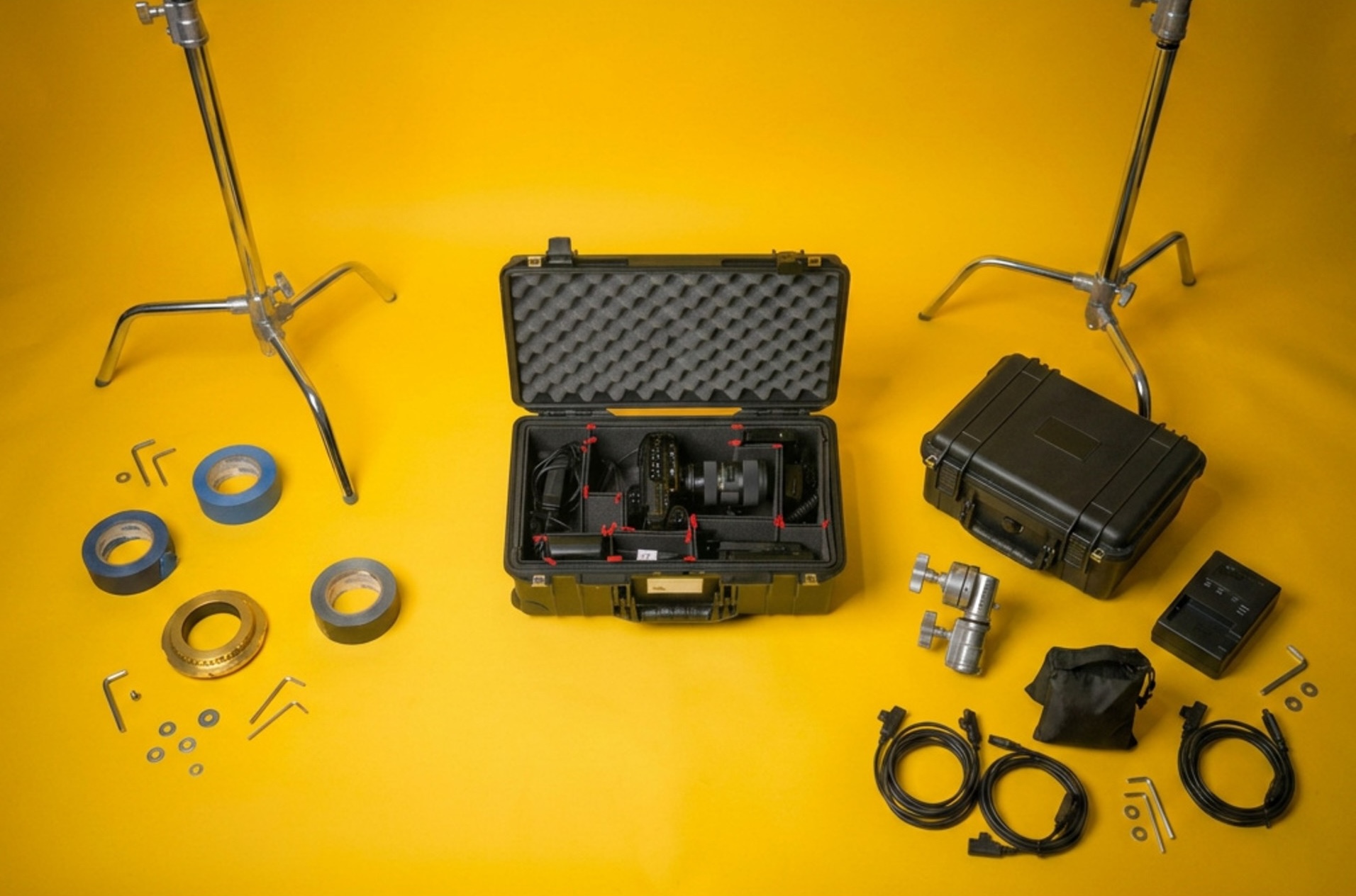
Tripods and lighting stands, which are large, awkward, and rarely the most expensive or hardest-to-replace item in a kit.Lighting equipment and modifiers (softboxes, stands, reflectors), assuming they're well padded and not carrying anything fragile inside them like bulbs.Backup or secondary gear you could genuinely complete a shoot without, if it came to that — the kind of equipment whose loss would be an inconvenience rather than a shoot-ending problem.Cables, chargers (without batteries installed loosely), and other lower-value accessories that don't carry the same replacement difficulty as a camera body.
If you're checking any of this, the packing fundamentals still apply: a hard-shell case with proper padding, clear labeling, and photographic documentation of contents before you hand it over.
The Real-World Argument for Checking Some Gear Anyway
It's worth being fair to the other side of this. Plenty of working photographers and crews do check substantial amounts of equipment, simply because the volume of gear required for some shoots makes pure carry-on logistics unrealistic — most airlines cap you at one carry-on and one personal item, and that ceiling doesn't stretch to accommodate a full production kit.
When checking becomes necessary, the calculation shifts from "should I check this" to "how do I minimize the risk on what I'm forced to check." That's exactly where airline media bag rates earn their value — they make checking larger volumes of gear financially reasonable, even though the underlying risk profile of checked baggage doesn't change. Media rate or not, the equipment most worth protecting is still the equipment that belongs in the cabin if there's any way to make that work.
A few practical ways photographers manage this trade-off:
Wearing a multi-pocketed jacket or vest to carry extra lenses or accessories on your body, separate from your carry-on allowance, when cabin space is especially tight.Shipping secondary gear ahead via insured courier rather than checking it, which removes the equipment from airline handling entirely and gives you a tracked, signature-required delivery instead.Splitting a kit across multiple travelers on the same crew, so no single bag carries an outsized concentration of irreplaceable equipment.
If You Have to Check Something Valuable
Sometimes there's genuinely no way around it — a gate agent forces a bag check due to cabin space, or your kit is simply too large for any combination of carry-on allowances. If that happens:
Use a hard-shell case, not a soft bag, and pack with enough padding that nothing inside can shift or collide.Photograph the contents before closing the case, so you have documentation if you need to file a claim.Add a TSA-recognized lock and visible labeling, understanding that neither one guarantees protection, but both reduce casual risk.Confirm what your travel or equipment insurance actually covers before you travel, since airline liability limits for checked electronics are often far below what professional gear is actually worth.
The Bottom Line
The near-unanimous opinion among working photographers isn't a coincidence — it reflects real, repeated experience with what happens to checked bags between the counter and the carousel. Camera bodies, primary lenses, batteries, memory cards, and anything irreplaceable belong in the cabin with you whenever it's physically possible. Tripods, lighting gear, and true backups are the more reasonable candidates for checked baggage, ideally packed in hard cases and documented before they leave your hands. And when volume forces your hand entirely, that's exactly the situation airline media bag rates were built for — making the unavoidable risk of checking equipment at least financially sensible, even if it doesn't make that risk disappear.
Airline liability policies and security screening procedures vary by carrier and country. Confirm current rules with your airline and review your insurance coverage before traveling with valuable equipment.


